Pace is a fictional 2-year-old consumer app — a goals coach for ambitious 28–45-year-olds
building habits across four life arenas. It's the case product used throughout the
AI-Native Product & Design Lab so every exercise compounds on the previous one's output.
Different domain from your day job. Same mechanics. Patterns transfer cleanly back.
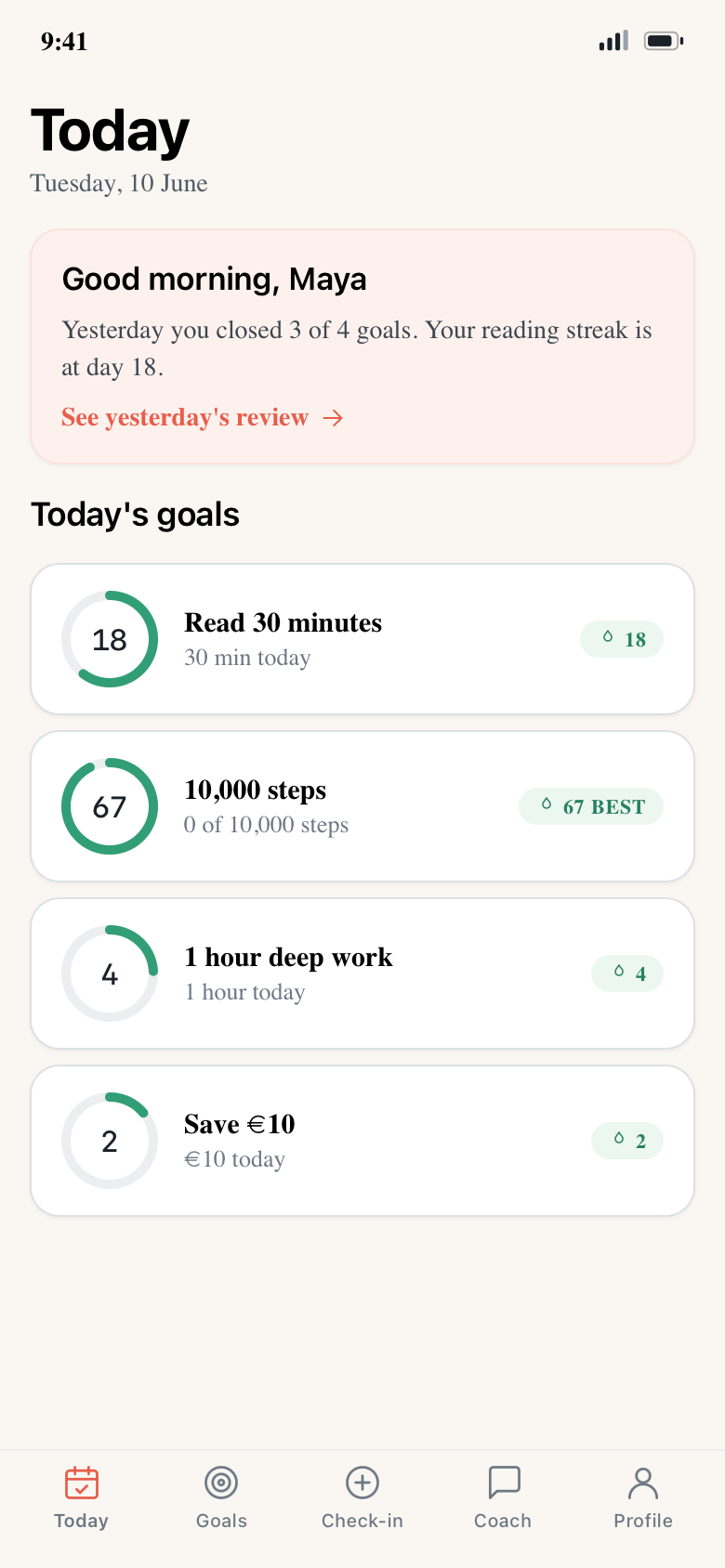
Pace · Today screen (B2C consumer mobile)∞ The story
What Pace is
Founded 2024 · raised $4M seed in 2025 · Series A in 2026. 120k MAU,
$1.2M ARR, $9.99/mo or $79/yr. Mobile-first iOS / Android with a web companion.
North-star metric: weekly check-in completion rate.
Pace's public Ideas board has 600+ user-submitted requests with ~15% dupes and ~30% stale.
Realistic mess — which is exactly what makes it a useful playground for AI-native PM and design work.
∞ Consumer personas (B2C)
Who Pace serves
We work with named users throughout the bootcamp. Every PRD critique, every design audit,
every prototype lands against a specific person — never "the user."
Maya Schwarz
32 · Product designer · Berlin
B2C
The Builder. Uses Pace as her daily planning brain — morning brief, evening reflection.
Pro user since launch · 4 active goals · 67-day longest streak
Loves AI coaching; complains the mobile nudges are too generic
The Lapser. Sets 6 goals at once; abandons by week 3 every time.
Free user · considered Pro twice, churned twice
Comes back every January with new ambitions
Asks for "smart pause" — auto-adjust when life gets busy
Sara Chen
45 · Ops director · New York
B2C
The Consistent. 380-day streak. Wants Pace to talk less and track quietly.
Pro since Jan 2024 (founding member)
2 simple goals — 10k steps, 1 reading session/day
Power user of Apple Health integration
⌘ Pace for Teams (B2B layer)
The second buyer surface
Pace for Teams is the employer-purchased benefit sold to HR / People at growth-stage companies.
Same product, different buyer. Two personas drive the B2B work — Devi (the buyer) and Caleb (the messenger).
Devi
44 · VP Sales, Pace for Teams · San Francisco
B2B
Owns the B2B revenue line. Wants M1 cleanup to surface B2B Ideas hidden inside the B2C backlog.
AI Leadership Team usage: Devi is the Sales persona in the S8 PRD stress-test
Lens: "will B2B customers pay more for this?"
Caleb
37 · Senior PMM, Pace for Teams · Berlin
B2B
Owns positioning + sales enablement + competitive intel. Wants every feature to come with a packaging recommendation.
Built the current sales deck; wants AI help making it per-prospect
Cares about deal-blocking objections + screenshot-friendly UI
Asks: "how do we package this? what story do we tell?"
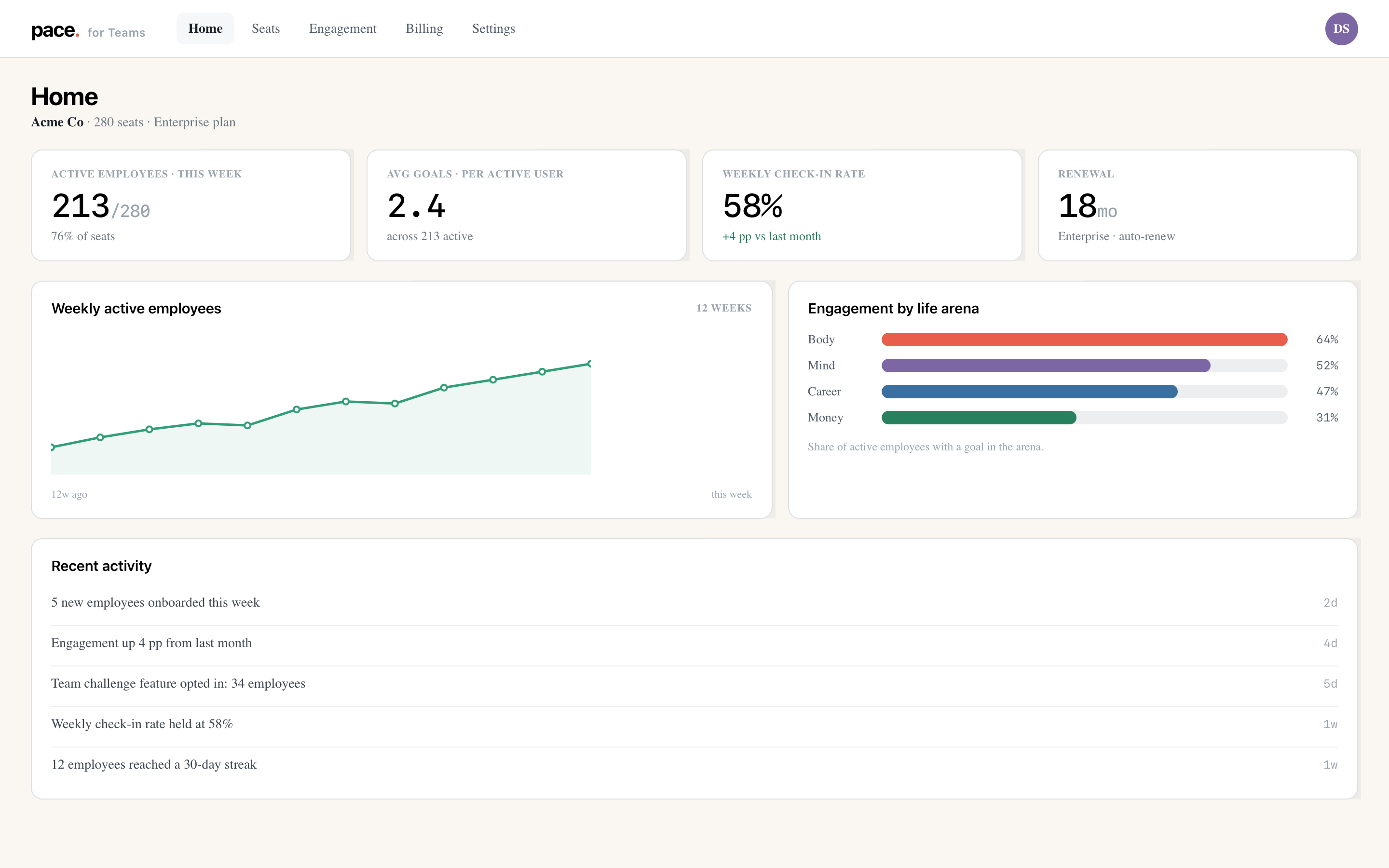
Admin home (web · 1440×900)
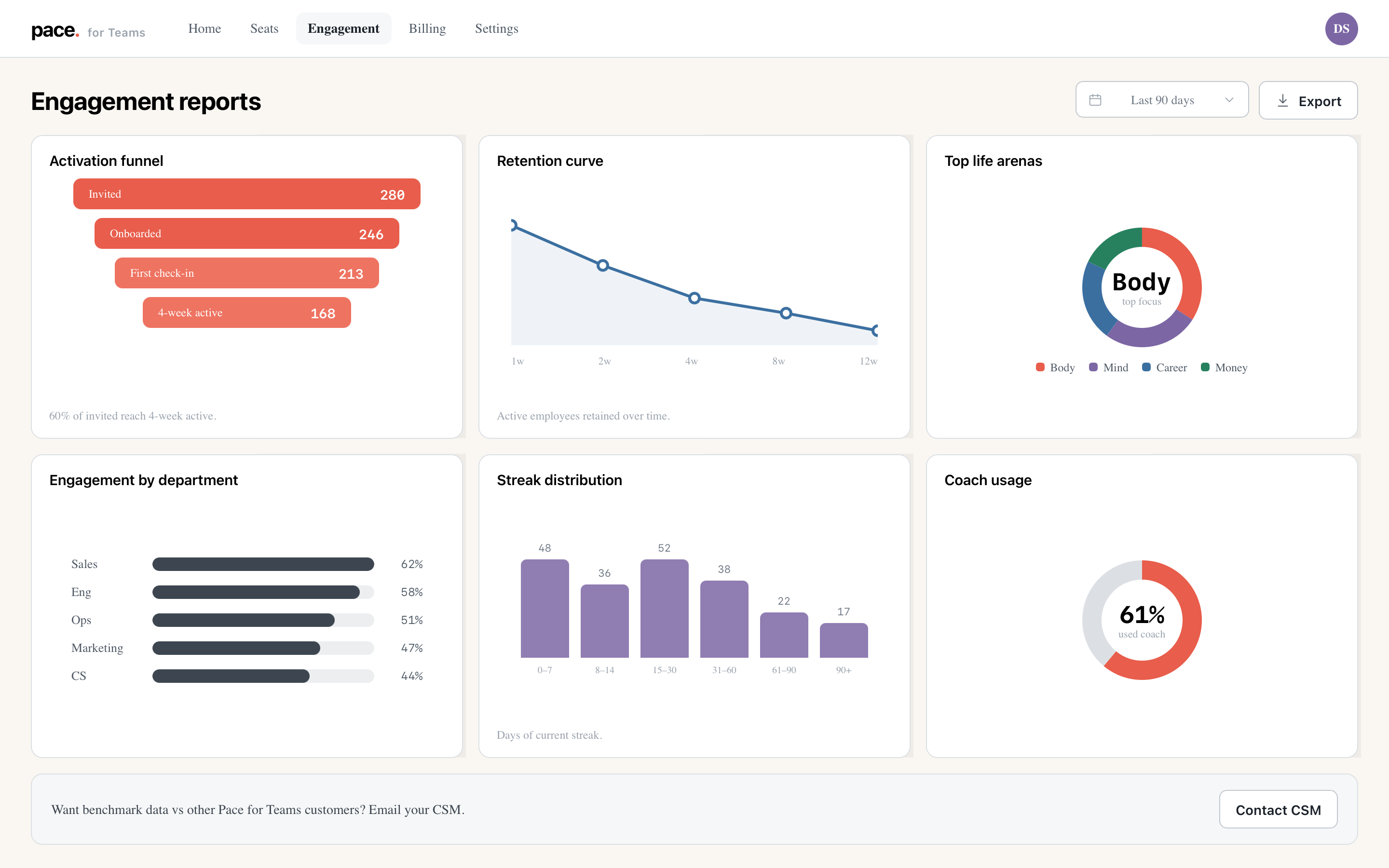
Engagement reporting
Δ Tech stack
How Pace is built
Mobile
React Native (iOS + Android)
Web companion
Next.js
Backend
Supabase (Postgres + auth + storage)
Design system
Pace DS v3 (Figma, mobile-first)
Product management
Aha! (Ideas → Features → Releases)
Integrations
Apple Health · Google Calendar · Slack
Wishlist
Spotify focus mode · Strava · Notion · Headspace
The bootcamp uses a synthetic Aha! workspace, a mock data API behind an MCP server, and a
forked mobile design system as Pace's DS. None of it is production — it's enough to make
every exercise realistic without exposing anyone's actual product data.
✦ Voice + brand
How Pace talks
Confident warmth. Data-forward when celebrating ("67 days, three goals on track" — not
"amazing job!!"). Honest about failure without toxic positivity. Never gamified for its own sake.
The Pace Design Critic — a Claude Project the cohort builds in S4 — enforces this voice
against any generated microcopy. Off-voice copy gets refused with a token citation.
Δ Why this case
Why not your real product?
Two practical reasons. First, no client data / tool access means we can practice safely on a
shared world — no NDA friction, no "you can't see this." Second, a shared case lets the cohort
compare outputs side-by-side: same brief, different pods, every artifact talks to every other.
The pattern transfers. You leave with the workflow on Pace, then apply it to your actual
backlog, your actual DS, your actual stack on Monday.